Subscribe via email

Enter your email address:

Delivered by FeedBurner

Who?

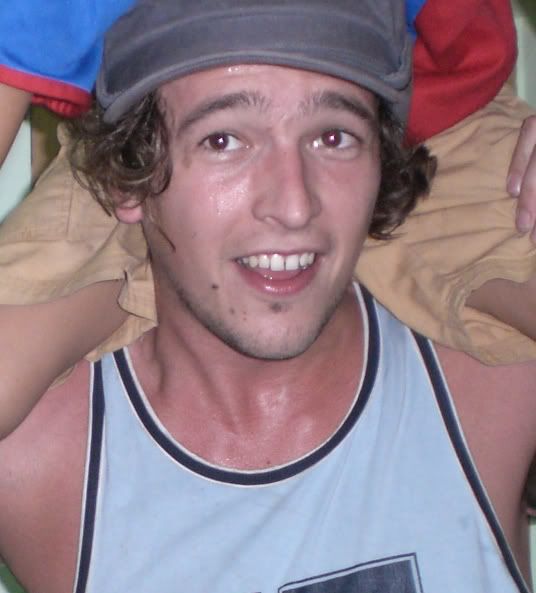
My photo
This blog is from 2007 - 2008. When this was going on: I'm trying to drive three Trabants 15,000 miles from Germany to Cambodia with a bunch of international accomplices. We set off from Germany on July 23rd, 2007, and hope to be in Cambodia by December. To see the route of our global odyssey, which we're calling Trabant Trek, go here: http://www.trabanttrek.org/route or www.myspace.com/trabanttrek
Showing posts with label US Military. Show all posts

Thursday, 25 October 2007

Birthday Boy

Birthday Boy
Bishkek, Kyrgyzstan
October 19th, 2007
By Dan Murdoch

TODAY was my birthday.
Twenty-five.
I woke up early, ate a healthy breakfast of fresh grapefruit and muesli, drank decaffeinated coffee without sugar, flossed, went for a jog, showered, removed hair from the plug hole, got a smart, respectable new look, put on clean, ironed clothes, applied for a mortgage, got a small business starter loan, and began the quest for a wife.
None of that is true, but I suppose some people think it should be. I imagine my grandfather would tell me that he had already founded and sold two newspapers by the time he was my age. My mother was raising her first child (me).
But times change, and my fellow trekkers, who are all older, seem to have just as few tangible links to responsible society as I do.
Once I have entered the cycle of job, home, family, bills etc it seems there will be little opportunity for gallivanting across the world until I retire from it all, in what forty years time? I don’t see the need to rush into the rat race, and I was strangely happy to celebrate my birthday in Bishkek, a city I hadn’t even heard of a few months ago.

We spent the afternoon doing a clear out of the cars- stripping them and cleaning them up, redistributing the weight more evenly and trying to get organised.
Tony put together a list of what is wrong with the cars:

Fez
Tyres bald
Rear control arm weld needs reinforcement
Front lights broken
Breaks very dodgy
Passenger door interior torn off
Speakers blown

Ziggy
Weld the bumper back into place
Fix the starter
Sticky throttle, replace cables
No mirrors
No turn signal
One headlight dim
Cracked cylinder head
Windshield wipers have been torn off
Look at brakes
Rear control arm weld needs reinforcement

Dante
Sticky throttle, replace cables
Starter wiring dodgy
Radio blown
New fuse box needed
There is no exhaust pipe
Strengthen rear control arm
Passenger door swings open randomly

I am told that ‘sticky throttle’ means the accelerator has a tendency to get stuck down: “Its fine on the highways,” Tony explained, “not so good in the cities.”
Photo Sharing and Video Hosting at Photobucket
We drank beer and I was presented with a cake, which was rather touching. Then we went to a restaurant for dinner, before heading to Metro, the six trekkers plus a bunch of new friends from the hostel.
The bar is a tiny microcosm of the West, almost like the set of Cheers has been displaced to the heart of Asia. You can order a burger or a burrito with your Bud. Sports channels churn out American football and baseball. On one corner TV the Air Force Network plays constantly. I had no idea there was such a thing as AFN, and it is a truly wonderful sight- a mix of wholesome US shows and sports interspersed with military advertising and warnings.
In the pub I couldn’t help but overhear snippets of conversation. A burly looking American with a crew cut: “I can’t imagine anything worse than being sent to an Afghan prison. I’ve seen Afghan jails and they are frightening. Must be the worst place on earth…”
A nerdy looking NGO type: “…you know they’re looking for a new macro consultant at DPNG. They need someone to work in their democratisation department…”
A strange group of contractors, the military and charity workers, eating pizza in their little oasis.
Photo Sharing and Video Hosting at Photobucket
From Metro to Golden Bull, via a tense standoff with some taxi drivers following an incident related to the etiquette of urinating in bushes.
It’s strange to be frisked by a man in military fatigues before you enter a club, but Westerners get in free at Golden Bull, for we are the money.
On Friday and Saturday night there are performances. A hooter sounds and evil looking henchman step in to clear the dance floor and keep the crowd orderly. Then the dancers step into the ring, normally a group of three or four boys or girls, all dressed up as gangsters, go-go girls or the like, performing well choreographed routines. Later in the evening some of the dancers get raunchier and expose a little flesh. It’s always impressive and breaks up the evening up nicely.
The women here love to dance and they pack the floor no matter what day of the week. There is always a ring of sour looking boyfriends standing around, staring menacingly at anyone who dances near their ladies.
The music in the club is generally rubbish, and my dancing is pathetic, truly terrible- I look a little like a deranged geography teacher having an epileptic fit at a trance party. So I get little joy from scaring people on the dance floor by shaking my thing to tunes I cant stand.
I tried it anyway.
It was rubbish.
Photo Sharing and Video Hosting at Photobucket
As I was the birthday boy, I was called on stage by Mikayel, my favourite gay pop star. He pretended not to know me, despite numerous introductions over the past month, and spoke in Russian a lot while I was on stage. The gang cheered loudly for me as I was presented with a bottle of something that smelled and tasted of old, fizzy vinegar.
Pretty much my last memory was sharing it with OJ, but I must have enjoyed myself because I was the last one back, arriving at the yurt alone at around 6:30am.
Carlos returned an hour earlier and had to break into the toilets to free OJ, who had fallen asleep on the crapper. Apparently he’d been locked in there for two hours, and when Carlos finally woke him, the big Slav threw up everywhere.

Being away from the cars for so long has given me a chance to walk. It sounds strange, but I haven’t really walked anywhere in months. A few nights ago I did the stroll from the centre of town back to the hostel. It was about three in the morning, and Bishkek was quiet. I felt calm in the ghostly silence of a sleeping city and the simple stroll gave my mind the chance to relax and wander.
A police car pulled up by a drunk-looking prostitute, and a dog trotted past on its own night time adventure. I passed a few emptying clubs, men and women spilling out onto the street to be heckled by taxi drivers.
Man was born to walk. As the only mammal to spend its days on two feet, it is something that defines us, that makes us human. The great evolutionary leap from the trees and onto our hind legs, freeing up our hands and allowing us to use tools, to build, to stroll about the savannah with a spear.
It was a mild night and I paced out a steady rhythm that my heart and lungs soon fell into time with, sending me into a meditation.
I must walk more, I thought.
I’ll file that one with ‘learn to dance,’ and ‘take more exercise’.
I'm only 25. Plenty of time.

Ends
Mrdanmurdoch@gmail.com
For more of Dan’s blogs go to: danmurdoch.blogspot.com or www.trabanttrek.org

Tuesday, 16 October 2007

Meeting the Military

Meeting the military
Bishkek, Kyrgyzstan
October 3rd, 2007
By Dan Murdoch

BISHKEK has a large ex-pat community, mainly due to the Air Force Base at the airport. Used by Americans as a hub to supply Iraq, and by the UN as a base for operations in Afghanistan.
I’d imagined there’d be loads of GIs around the city, but there wasn’t a crew cut in site.
“US troops aren’t allowed off the base anymore,” an American contractor explained to me in a local bar, “they used to be allowed off but it didn’t work out. You have to remember, these guys aren’t like you and me, they’re not travellers. If someone bumps your elbow in the street you say hello. If these guys get jostled in the streets then they fight. They don’t understand being abroad. So they’re restricted to base after there was a bit of trouble.
“Bishkek is a transport hub. The troops on base could be anyone. They might be coming from operations in Afghanistan or Iraq, they could be straight from home, or they could be reservists.”
It must be strange coming from guarding a base in Iraq, where every local is a potential threat, to coming here.
“Damn straight. There was a big problem a few months ago when some guards at the base shot a local dead for carrying a screwdriver. That didn’t go down well with the Kyrgyz government.”
I asked how many troops there were at the base. He stepped back and raised his eyebrows.
“What?” I asked, “Do you know?”
“Oh I know alright, but that’s not the sort of question you’re supposed to ask,” he looked around then leaned in closer conspiratorially, “lets just say there’s more than 500, but not as many as 1,500.”
Photo Sharing and Video Hosting at Photobucket
Later that evening the same line of questioning got Carlos and I into trouble.
During a visit to the local club, Golden Bull, Carlos was surprised to bump into a load of Spanish military. Naturally two of his first questions were: “What are you doing here?” and “How many of you are there?”
He got talking while I was having a brief nap in the lavatory. They were part of the UN mission in Afghanistan.
Carlos found me and took me to meet them, but I was too tired to overcome the language barrier and instead napped on a sofa.
He woke me at about four or five am, as the club was closing, he was still happy, laughing and joking with the Spanish. But in the space of the 100m walk from my resting place to the door it all changed.
I'm not sure what was said, but they became very angry and aggressive. There was a lot of shouting. They demanded passport numbers, identification cards, papers.
“Your friend is not English,” Carlos translated what they were saying, “Your friend is not English and you have nothing to do with any NGO.”
They were accusing us of being spies, based on Carlos’ early questions and something I must have said in an inebriated state during our walk to the door.
“What did you say Dan?” he asked me, shaking slightly, “did you say anything to them about ETA of Al’ Qaeda?”
It was impossible to say.
I admitted I might have blurted anything out. It was quite upsetting, particularly for Carlos who had previously been enjoying some camaraderie with his compatriots.
We stayed inside hoping they would leave, but they laid in wait, and we ended up having to sneak away.

A few days later we bumped into the Spanish military again. Carlos asked what had happened that night, but they would only respond: “We cannot tell you. We cannot tell you.”
But they did say that they thought I was a German.

I ordered a fry up at a place called Fat Boys along the strip. The ingredients were correct- bacon, sausage, eggs, beans, toast- but somehow it was wrong, cooked a little different, strange brands, it wasn’t right.
Surrounded by English and American accents- I could have been nursing a hang over at home. It was hard not to overhear the American next to me: “I came here in ’94. It was completely different then.”
He spoke in that slow ponderous way of some American southerners: “Everything stopped at eight pm, all the transport, all the traffic. There were almost no lights in the city at night. It was dangerous to walk around just because you couldn’t see anything.
“Things have changed a heck of a lot. That’s right.”


The walk from the cafĂ©, near the President’s palace, to our accommodation on the other side of town was a slow descent into degradation. I passed a whole family of beggars- eldest son in a wheelchair, youngest son squealing on a chunk of cardboard, mother squatting open palmed and sad eyed, clutching a grimy baby. Further on an old man sat with his scarf-swaddled wife in front of a lonely pile of grapes and stared at a pocket watch as if time had stood still. They had cleverly set up stall outside the supermarket, stealing custom from the big chain. But few people stopped at their forlorn stand. The couple’s main competitors in the fast grape market were some fat, angry-looking Russian women.
The fall of the Russians. What status did these bleach blonde babushkas enjoy before the Soviet rug was pulled from under them? Now they sit with the Kyrgyz and compete to sell bruised fruit.
Photo Sharing and Video Hosting at Photobucket
We were told our accommodation was student digs, but I saw few students there. The residents seemed to be the down on their luck, fallen-on-hard-times types: old men with crumpled fedoras and unironed shirts, a girl in her thirties with a perpetual scowl and a middle aged woman who refused to meet my eyes and ignored my daily greeting.
The courtyard was a menacing mix of old industrial waste, concrete slabs, metal pipes, bald tyres, and playful children.
One night the beggars who live under a curve in a pair of thick-set pipes set light to a few tyres and sat around the toxic smoke swigging vodka and shivering in their rags.
The next morning I kicked a football about with a few kids and a man in his early thirties approached and tried to head butt me. I wasn’t sure what he was shouting, and hoped he was being playful, but a kid behind him drew his finger across his throat and gestured that I should scarper.
Walking home late that evening, alone in the dark, a youngish man approached me. He was carrying a beer, and seemed a little the worse for wear, but didn’t come across as threatening.
“Why you walk alone? You have no friends?”
I thought he was mocking me: “No I have friends, they’re back at the apartment.”
“You not walk alone. This very dangerous. Many bad, bad men.”
I pulled my bag closer to me, felt the outline of my laptop jutting through the canvas, the lump of my camera protruding from my pocket, the mobile phone snuggled next to it, and my wallet, misleadingly fat with single dollar bills.
“This bad city. Bishkek dangerous. At night never alone.
“I work in Almaty. Big money there. I manage shop. $700 for one month. Here $300. Big money, oh yes, Kazakhstan beautiful. Money, money, money. Not dangerous like Bishkek. Here no money, many bad man.”
He took great pains to walk me near to my street then, for a reason I could not fathom offered me a small amount of cash, which I refused, and then he waved me off.
When I arrived outside our block two young men shouted at me in Russian, making me catch my breath. I was relieved to turn and see them clutching their heart in the local greeting.
I remembered the parting advice of one of the Richter ladies who had found the place for us: “Don’t leave your documents in your room, It is not safe.”
How reassuring, thanks for looking after us.
The following day I told a friendly waiter in a nearby restaurant that I was staying near Osh Bazaar: “You must be careful,” he replied, “Bishkek is a dangerous and criminal place. There is a lot of bad people here, especially at the bazaar. You must be careful.”
At night the babushkas close a thick iron grill across the entrance to our corridor. I'm not sure if it makes me feel safe or not.

The following day I was relieved to be told by Richter that we had outstayed our welcome in their free accommodation. They explained that there was a conference taking place for nurses from all over Kyrgyzstan and our rooms had been booked up. We had been there two weeks, it seemed fair enough.
The Richter girls showed us to a pleasant family run hostel already full of tourists, where there were showering facilities and a breakfast option, all for $6 a night.
I was pleased to get away from the seedy Osh Bazaar, but four days later I returned to pick up some contact lenses that I had forgotten, and our rooms, the ones booked up by the nurses, stood glaringly empty.

Ends
mrdanmurdoch@gmail.com
For more of Dan’s blogs visit: danmurdoch.blogspot.com or www.trabanttrek.org